Herbal Hair Tonic
After seeing so many hair and scalp serums pop on my radar, and because of the abundance of herbs I have growing right now - this product created itself. It is a multidimensional hair and scalp tonic for vitality, resilience, shine, and abundance.
This formula draws from European folk herbalism, Appalachian traditions, and Ayurveda. Traditional herbalists cultivate the conditions from which healthy hair naturally emerges: robust circulation, nourishment, moisture balance, tissue integrity, and a calm, thriving scalp. This recipe works synergistically to stimulate the scalp, nourish the follicles, soothe irritation, strengthen the hair shaft, and impart softness and shine.
The Formula
5 parts Rosemary — circulation, vitality, follicle support
3 parts Sage — strengthening, balancing, darkening
3 parts Nettle — nourishment, density, resilience
2 parts Mint (peppermint or spearmint) — stimulation, freshness, scalp comfort
2 parts Hibiscus — shine, softness, breakage prevention
1 part Calendula — soothing, healing, scalp restoration
1 part Comfrey Leaf — conditioning, tissue support, softness
1 part Lavender — harmony, scalp balance, calming
1 part Horsetail — silica, structure, strength
A "part" may be any measure—a handful, scoop, tablespoon, or cup—depending on the size of batch desired.
Optional: choose an essential oil blend below to heighten the potency.
Preparation
Place herbs into a large heatproof jar or pot.
Pour nearly boiling water over the herbs (approximately 4–5 cups water per cup of dried herbs).
Cover immediately and steep for 4–12 hours, preferably overnight.
Strain and cool completely.
How to Use
Several Methods
Try not washing your hair for a whole week. Use the rinse daily for freshness and infused herbal vitality, either pour a small amount into your hands and vigorously massage into scalp, or .
After shampooing, slowly pour the infusion over the scalp and hair, massaging gently into the roots. Leave in or rinse lightly after several minutes.
Pour into a spray bottle and mist yourself liberally, daily, hourly, your choice! This would be safe for your face and skin as well, as long as the essential oils don’t get in your eyes. This is my favorite method and definitely the easiest to apply.
Philosophy of the Formula
Traditional herbalists viewed hair not as an isolated cosmetic concern but as a reflection of vitality, nourishment, circulation, and balance. Rosemary awakens. Sage strengthens. Nettle nourishes. Mint refreshes. Hibiscus beautifies. Calendula heals. Comfrey restores. Lavender harmonizes. Horsetail reinforces. Together they create what generations of herbalists seek: a healthy, vibrant scalp ecosystem from which thick, glossy, resilient hair can naturally emerge.
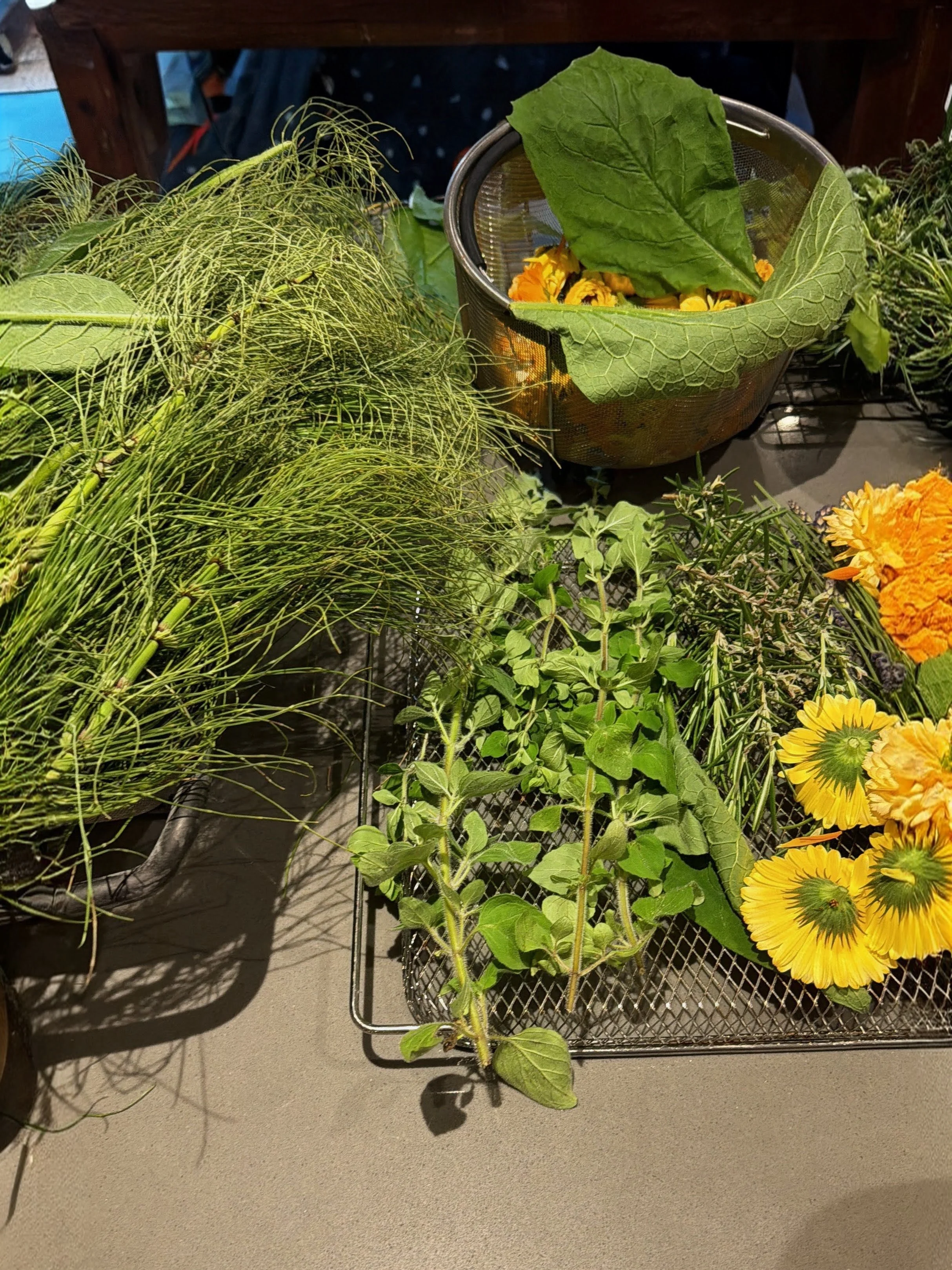
Horsetail, mint, rosemary, sage, comfrey and calendula
Materia Medica
Rosemary — The Awakener
The most celebrated hair herb in Western (especially Greek and Roman) herbal traditions.
Modern Understanding
Rosemary contains rosmarinic acid, carnosic acid, and numerous antioxidant compounds that support scalp circulation, reduce oxidative stress, and help maintain healthy follicle function.
Folk Wisdom
Rosemary was believed to awaken dormant vitality and restore vigor to thinning, dull, or aging hair. It was traditionally used whenever the scalp felt sluggish or the hair lacked life.
Sage — The Strengthener
Rosemary's traditional companion.
Modern Understanding
Sage possesses antimicrobial and astringent properties that help balance excess oil while providing antioxidant support.
Folk Wisdom
Associated with longevity and wisdom, sage was commonly used to strengthen roots, darken graying hair, and improve the condition of mature hair.
Nettle — The Nourisher
The classic "hair food."
Modern Understanding
Nettle provides minerals including silica, potassium, magnesium, and iron while helping calm inflammation within the scalp environment.
Folk Wisdom
Herbalists often described nettle as feeding the roots. It was frequently recommended after illness, stress, childbirth, or periods of excessive shedding when the body needed rebuilding.
Mint — The Refresher
Modern Understanding
Menthol creates a cooling sensation, increases local circulation, and helps relieve itching and discomfort.
Folk Wisdom
Mint was thought to refresh stagnant energy, invigorate the scalp, and restore vitality and freshness.
Peppermint is more stimulating; spearmint is gentler and more balancing.
Hibiscus — The Beautifier
Classic Ayurvedic hair herb.
Modern Understanding
Rich in anthocyanins and antioxidants, hibiscus helps smooth the hair cuticle, increase shine, and reduce breakage.
Folk Wisdom
Used traditionally to maintain long, lustrous hair and encourage softness, flexibility, and resilience.
Calendula — The Healer
The herb of repair and restoration.
Modern Understanding
Calendula supports healthy skin barrier function, calms inflammation, and encourages healthy tissue regeneration.
Folk Wisdom
Whenever skin needed soothing or mending, calendula was often the answer. In hair preparations it helps create a healthy environment for the scalp and follicles.
Particularly valuable for:
Dry scalp
Flaking
Irritation
Sun exposure
Chemical processing
Comfrey Leaf — The Knitter
One of the finest conditioning herbs available.
Modern Understanding
Comfrey contains allantoin, mucilage, rosmarinic acid, and minerals.
Its mucilage naturally coats the hair shaft, improving slip, softness, and moisture retention. Allantoin supports healthy skin and scalp tissue.
Folk Wisdom
Known traditionally as "knitbone," comfrey was used wherever tissues needed support and restoration. In hair care it was valued for improving softness, reducing brittleness, and restoring damaged hair.
If calendula heals the scalp, comfrey nurtures the hair itself.
Together they create one of herbalism's classic restorative pairings.
Lavender — The Harmonizer
Modern Understanding
Lavender possesses anti-inflammatory and antimicrobial properties while helping maintain a balanced scalp environment.
Folk Wisdom
Long associated with peace and harmony, lavender was included in grooming preparations to calm irritation, reduce stress, and support overall scalp wellbeing.
Horsetail — The Builder
Modern Understanding
Horsetail is exceptionally rich in silica, a structural mineral associated with healthy hair, skin, and connective tissues.
Folk Wisdom
Used to strengthen weak, brittle, or fragile hair and improve resilience over time.
Optional Essential Oil Enhancement
Add to approximately 8 oz (240 ml) of cooled rinse:
5 drops Rosemary
4 drops Cedarwood
3 drops Geranium
2 drops Frankincense
2 drops Sandalwood
Shake before each use.
Essential Oils and Their Mechanisms
Rosemary
o Further enhances circulation and vitality.
Cedarwood
o Traditionally used for thinning hair, scalp congestion, excess oil, and dandruff. Deeply grounding and strengthening.
Geranium
o Balances both dryness and oiliness while promoting softness and shine.
Frankincense
o Associated with renewal, rejuvenation, and graceful aging of skin and scalp.
Sandalwood
o Cooling, moisturizing, and restorative for dry, sensitive, or weather-exposed scalps.
Customizations
For Hormonal or Midlife Hair Changes
o Clary Sage, Rosemary, Geranium, Helichrysum
For Oily Scalps
o Juniper Berry, Rosemary, Cedarwood, Sage
For Dry, Mature, or Curly Hair
o Ylang Ylang, Sandalwood, Patchouli, Frankincense
For Shine and Luxury
o Rose, Jasmine, Ylang Ylang, Jasmine, Sandalwood
For Scalp Irritation
o Lavender, Calendula, Frankincense, Patchouli
Notes
Add Vitamin E in 1-2% dilution to total liquid volume to further preserve. Add a splash of Aloe Vera if hair is brittle and you don’t mind the heaviness.
Interested in a personalized consultation, product formulation or skills class? Learn about opportunities to connect here. Have a beautiful day!